The Duravant family of operating companies serve the food processing, packaging and material handling segments.

Choosing the right Fishing Net starts with a simple question: what will you use it for? A small landing net for a stream has different needs from a wide net used to bring baitfish aboard. The fish’s size, the water depth, and the space around you all affect the choice. So does the way you fish. A long handle can reach past a riverbank, but it may feel awkward in a crowded boat.
Look closely at mesh size, material, frame strength, and handle length. Knotless, softer mesh can help reduce rubbing on a fish’s skin, while a sturdy frame is useful when lifting heavier catches. Smaller openings may hold tiny fish, but they can also collect weeds and debris. Check the net’s weight and storage needs, too. A net that stays in the car because it is bulky is not much help at the water.
There is no perfect net. The best choice is a practical match for your usual conditions, not the most expensive option on a shelf. Read product specifications carefully, and inspect joints, mesh, and handles before use. If you are unsure, compare a few nets in person; feel matters. These details are easy to overlook, and I would not claim one design works for every angler. This guide explains the trade-offs so you can choose with care, protect your catch, and avoid buying features you may never need.
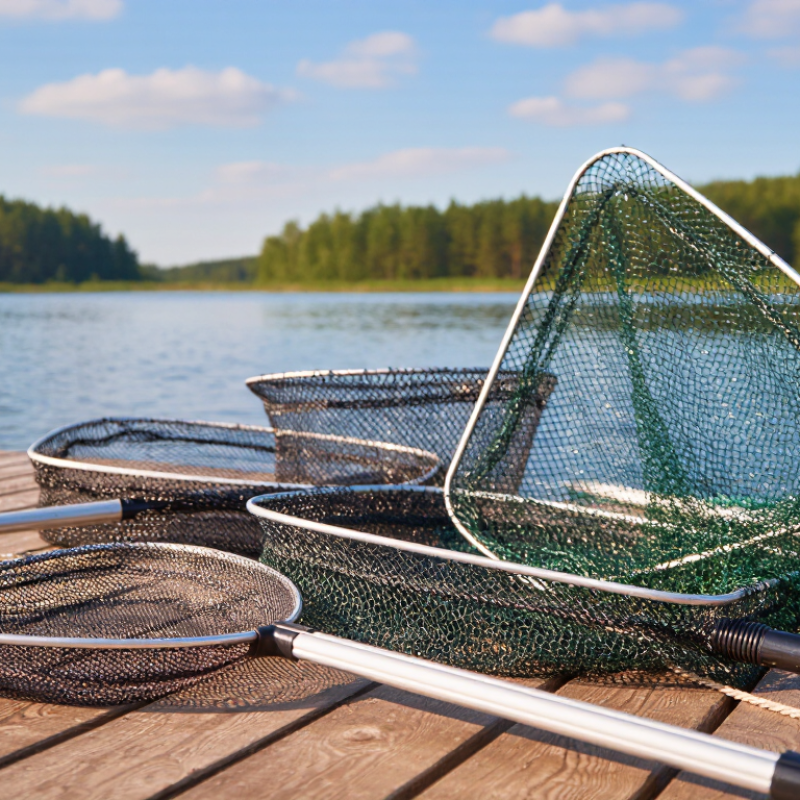
Begin with the kind of fishing you plan to do. A landing net helps bring a hooked fish within reach from shore, a dock, or a boat. A dip net suits shallow water and quick scooping, while a cast net is designed to spread over baitfish in suitable open water. Check local rules before using one. The details matter.
Then consider your target species and its typical size. A small trout needs a lighter frame and fine, knotless mesh; a large fish calls for a wider hoop and a sturdy handle. Mesh that is too coarse can snag fins or gills, while an undersized net may stress the fish during landing. For catch-and-release fishing, choose soft, fish-friendly mesh and keep the fish in the water when practical.
Think about where you will carry and use the net. A long handle can reach fish beside a high bank, but it may feel awkward in a narrow stream. A folding frame packs easily, though its joints need checking for looseness. A common mistake is choosing by hoop size alone. I’d also weigh the net’s reach, mesh, and storage needs; that balance is easy to overlook.
Fishing nets serve different jobs. A landing net has a long handle and a framed bag, useful for lifting a hooked fish from the water without hauling the line. Knotless, soft mesh can help reduce scale and fin abrasion. A cast net spreads from the hand and sinks over small baitfish in open, relatively shallow water. It needs room to open. A seine net catches fish in a bounded stretch of water; one person or a team draws it toward shore. That takes coordination and a clear route, not just a strong net.
Mesh size, depth, current, and access all matter. Mesh size alone is an imperfect shortcut; a net that suits a quiet pond may be awkward on a rocky bank. The FAO’s The State of World Fisheries and Aquaculture 2024 reports 185.4 million tonnes of aquatic animal production in 2022 across capture fisheries and aquaculture. That broad figure reflects many different fishing settings, not one ideal gear choice. For occasional shore fishing, a compact landing net may be easiest to manage. For bait collection, check local conditions and choose a cast net sized to the target fish. For a seine, consider the space and help available. Small details matter. A little too much net can be a nuisance.
Compare common net types by how they are typically operated. The chart uses category codes, not performance scores: 1 = actively moved; 2 = set in place for fish to encounter.
Choosing a net: Cast nets are thrown over fish in shallow water; seine nets surround or sweep fish; gillnets entangle fish that swim into the mesh; trawl nets are towed through the water; and dip nets scoop individual fish. Local regulations, target species, mesh size, and fishing conditions should guide your choice.
Mesh size should match the fish you expect to handle. Small fish can slip through coarse openings, while very fine mesh may trap weeds and drain slowly. For catch-and-release, consider soft, knotless mesh to reduce abrasion on scales and fins. Check the opening itself rather than relying only on a label; sizing descriptions are not always consistent. A ruler helps. So does a close look.
Material affects weight, drying time, and durability. Rubber-coated mesh is often easier to rinse clean, while lightweight nylon is easier to carry but may snag or wear faster. Feel it first. Check the seams where the mesh joins the frame, and look for secure joints that do not wobble under gentle pressure. A sturdy handle matters when the net is wet and holding a fish. It is easy to focus on the hoop’s size and overlook these details. I would not choose a net by appearance alone; the best balance depends on your typical catch, storage space, and how often you fish. The trade-off may not be perfect.
Choosing net dimensions starts with the fish you expect to land, not the largest net you can carry. Measure the hoop opening and bag depth separately; they solve different problems. A wide hoop gives a fish room to enter, while a deeper bag helps keep it contained during a brief lift. Measure twice.
For shore fishing, a longer handle can reach beyond rocks or a steep bank, but it may feel awkward in brush. On a small boat, a shorter handle is easier to control and store. Match the hoop to your target fish: it should be wide enough for the fish to turn into the opening without forcing its body sideways. A net that looks generous on dry land can feel cumbersome when wet.
Bag depth matters too. A shallow bag may let a lively fish jump out, while an excessively deep one can drag in weeds or water. Mesh size and material affect handling, so consider the fish’s size and the conditions where you fish. I still check the net beside my usual landing spot; measurements alone miss snags, current, and awkward footing. A little extra reach helps sometimes, but it is not always worth the added weight.
Use these practical starting points to match net dimensions to your fishing conditions. Measurements are general examples; local fishing regulations may restrict net type, mesh size, or use.
| Fishing condition or target | Suitable net type | Useful net dimensions | Mesh guidance | Why these dimensions work |
|---|---|---|---|---|
| Small fish in a stream or pond | Hand landing net | Hoop: 30–40 cm wide; handle: 30–60 cm | Small openings, around 6–10 mm | A compact hoop is easy to maneuver in confined water and helps keep small catches from slipping through. |
| General freshwater fishing from shore | Landing net with a telescopic handle | Hoop: 40–55 cm wide; handle: 1.2–2 m when extended | Openings around 10–20 mm, matched to the expected catch | The longer handle reaches fish from a bank while remaining manageable for routine use. |
| Larger fish from a boat or deep bank | Deep landing net | Hoop: 55–75 cm wide; handle: 1–1.8 m; bag depth: 50–75 cm | Medium openings or knotless mesh to reduce snagging and abrasion | A wider hoop and deeper bag provide room for larger fish; choose a handle length that suits the boat side or bank height. |
| Shallow water or catch-and-release fishing | Rubber-mesh landing net | Hoop: 40–60 cm wide; bag depth: 35–60 cm | Rubber-coated or knotless mesh, with openings sized for the fish | Rubber and knotless mesh can reduce hook tangles and are generally gentler on fish than rough, knotted netting. |
| Catching small baitfish where permitted | Cast net | Radius: about 1.2–2.4 m (4–8 ft), selected for the angler’s reach and casting ability | Small mesh, often about 6–12 mm; confirm local rules and target size | A smaller radius is easier to cast; a larger radius covers more area but requires suitable space and technique. |
| Wading or fishing around rocks and vegetation | Compact landing net with a short handle | Hoop: 35–50 cm wide; handle: 30–75 cm | Knotless mesh with openings suited to the target fish | A shorter handle and moderate hoop are easier to control where long handles can catch on rocks, brush, or current. |
Measurement note: Hoop width is measured across the opening, bag depth from the hoop to the bottom of the net, and cast-net radius from the center to the outer edge when spread. Mesh measurements can be specified in different ways, so check how the opening is measured before comparing nets.
Before choosing a fishing net, check your local fisheries authority’s current rules. Requirements can vary by waterway, season, and target species. Confirm permitted mesh size, net dimensions, set locations, soak times, and gear-marking requirements. Ask an officer if a rule is unclear. Keep a screenshot or printed copy of the guidance with your gear. I still double-check.
Maintenance matters, too. After each trip, rinse the net with fresh water and spread it out to dry fully. Check knots, seams, floats, and weights for damage; a small tear can widen under strain. Repair worn sections promptly, and never leave damaged gear near the water.
A 2018 Scientific Reports study estimated that fishing nets made up at least 46% of the mass of the Great Pacific Garbage Patch. That figure concerns one ocean accumulation zone, not every fishery, but it shows why preventing loss matters.
Store nets loosely, away from sharp edges and direct sunlight, and follow local guidance for disposal of gear that cannot be repaired.