How to Choose the Best Generator Sets?
Choosing the right Generator Sets begins with the work they must support, not the largest rating on a brochure. A small clinic, a construction site, and a cold-storage room have very different demands. List every essential load, then note its running power and starting surge. Motors, pumps, and compressors can briefly draw far more power when they start. That detail matters.
An illustrative industry specialist, Alex Morgan, offers this practical reminder: “Size the generator for the real load, including startup peaks—not just the number on the equipment label.” Treat that as a guiding principle, not a substitute for a documented load assessment. Compare the required kW and kVA, voltage, phase, and frequency. Check fuel availability, expected runtime, site altitude, temperature, and ventilation. A set that looks right on paper may struggle in a hot, dusty enclosure.
The best choice also fits the operating plan. Consider automatic transfer equipment, sound limits, service access, spare parts, and routine maintenance. Ask suppliers for performance data and clear warranty terms. Have a qualified power professional verify the sizing, especially where sensitive electronics or critical loads are involved. This guide will explain how to assess capacity, fuel type, installation conditions, and lifecycle costs. It will also point out a common trap: buying extra capacity without checking how the set performs under normal loads. Bigger is not always better. A careful choice can protect equipment, reduce avoidable running costs, and provide dependable backup when the lights go out.
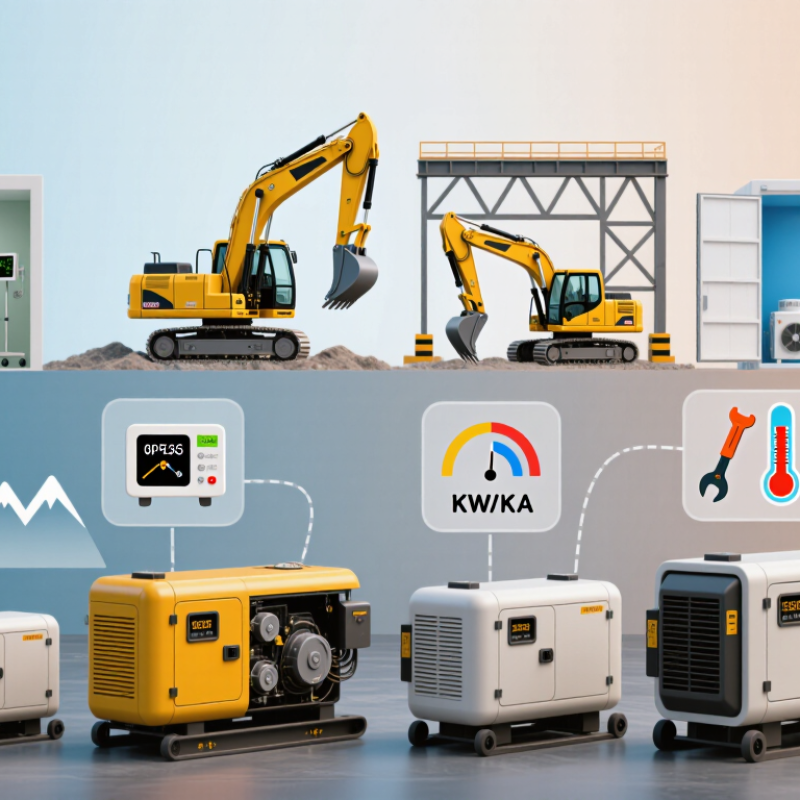
Assess Your Power Requirements and Essential Loads
Choosing a generator set begins with a realistic load list, not the biggest unit available. Walk through the site and note which equipment must keep running during an outage. This might include a refrigerator, water pump, heating controls, selected lights, or communication equipment. Check each item’s nameplate for voltage and running watts. Motors often need extra power briefly when starting. Don’t overlook that surge.
Separate essential loads from conveniences, then estimate which items may operate at the same time. Add their running wattages and allow for the largest startup surge; if several motors can start together, account for that possibility too. Compare your estimate with the generator’s continuous rating, not only its short-term maximum rating. Leave reasonable spare capacity for small additions, but avoid sizing around appliances you rarely need. A common planning miss is counting a pump’s running demand while ignoring its startup draw. The first estimate may be wrong. Recheck it against actual nameplates and how the site is used. Fuel runtime, starting method, and installation conditions also matter; a qualified electrician can verify fixed connections and transfer equipment.
How to Choose the Best Generator Sets? - Assess Your Power Requirements and Essential Loads
Use the figures below as planning estimates. Actual wattage varies by appliance, motor design, operating conditions, and manufacturer specifications. Check each appliance’s nameplate or manual before selecting a generator.
Typical Household Loads for Generator Planning | Essential Load | Typical Running Watts | Typical Starting Watts | Planning Notes |
| Refrigerator or freezer | 500–800 W | 1,200–2,400 W | Compressor startup can briefly require substantially more power than normal operation. |
| Sump pump | 600–1,000 W | 1,300–2,500 W | Use the pump’s nameplate data; larger pumps may require more starting power. |
| Gas furnace blower | 400–800 W | 800–1,800 W | Estimate excludes other furnace components unless listed separately. |
| Window air conditioner | 500–1,500 W | 1,000–3,000 W | Starting demand depends on unit size and whether it has a soft-start feature. |
| Microwave oven | 1,000–1,500 W | About the same as running watts | Use electrical input watts, which may be higher than the advertised cooking output. |
| LED lighting | About 8–15 W per bulb | About the same as running watts | Add the wattage of all lights expected to be on at the same time. |
| Wi-Fi router and modem | 10–30 W | About the same as running watts | Check adapter labels for the actual power requirement. |
Worked Example: Essential-Load Estimate | Selected Load | Quantity | Running Watts per Item | Starting Watts per Item | Running Subtotal | Starting Surge Increment |
| Refrigerator | 1 | 700 W | 2,200 W | 700 W | 1,500 W |
| LED lights | 10 | 10 W | 10 W | 100 W | 0 W |
| Wi-Fi router and modem | 1 | 20 W | 20 W | 20 W | 0 W |
| Sump pump | 1 | 800 W | 2,000 W | 800 W | 1,200 W |
| Furnace blower | 1 | 600 W | 1,800 W | 600 W | 1,200 W |
| Microwave oven | 1 | 1,200 W | 1,200 W | 1,200 W | 0 W |
| Window air conditioner | 1 | 1,000 W | 2,000 W | 1,000 W | 1,000 W |
| Total running load | 4,420 W | — |
| Estimated peak demand if the largest motor starts while other listed loads are running | 4,420 W + 1,500 W = 5,920 W |
| Estimated continuous-output target with approximately 20% reserve | About 7,100 W (7.1 kW) |
| Example selection | Choose a generator with at least about 7.1 kW of rated continuous output, subject to its surge rating and the appliance manufacturers’ requirements. |
Important: The example assumes motor loads start one at a time. If several motors may start simultaneously, calculate their combined starting demand or use load management. Compare appliance demand with the generator’s rated continuous output—not just its maximum or surge rating—and confirm voltage, outlet, and transfer-switch requirements with a qualified electrician.
Compare Generator Types, Fuel Options, and Power Ratings
Choosing a generator set starts with its duty: portable units suit temporary, smaller loads, while permanently installed standby sets support fixed backup needs. Inverter generators can provide stable output for sensitive electronics, but their capacity may be limited. List the equipment you need to run, including pumps, refrigeration, and lighting. Check both running watts and starting requirements; a pump may briefly demand more power when its motor starts. Small details matter.
Fuel choice depends on supply, runtime, storage, and maintenance. Diesel is common for heavier-duty applications, while natural gas can suit sites with a reliable pipeline. However, pipeline supply may be interrupted during some emergencies. The U.S. Energy Information Administration’s Electric Power Annual reports that natural gas generated about 43% of U.S. utility-scale electricity in 2023. That figure describes the wider power system, not generator-set performance, but it shows how central gas is to energy supply. Compare fuel availability at your site, not just headline fuel prices. For ratings, ISO 8528-1 distinguishes operating categories such as standby and prime power; match the rating to expected hours and load profile.
Tips: Add essential loads, then check motor-starting demand and leave a practical margin. Ask a qualified technician to verify the rating against altitude, temperature, and site wiring. Sizing is not perfectly tidy; real loads change, so review your assumptions before buying.
Check Electrical Compatibility and Required Features
Check Electrical Compatibility and Required Features
Start with the loads the generator set must actually serve, not the total printed on equipment labels. Record each item’s voltage, phase, frequency, running watts, and starting demand. Motors, pumps, and compressors can draw several times their normal current briefly during startup. The U.S. Department of Energy’s generator guidance recommends matching capacity to the appliances or equipment being powered; a simple wattage total can miss this surge.
Small details matter. Check whether the site needs single-phase or three-phase output, and confirm that connected equipment accepts the generator’s voltage and frequency. A mismatch may damage sensitive controls or prevent reliable operation.
Match Features to the Job
Required features depend on the job. For emergency systems, NFPA 110 defines a Type 10 system as one designed to restore power within 10 seconds. That target affects transfer equipment, controls, and generator sizing. For variable loads, consider voltage regulation, frequency stability, weather protection, and remote alarms. Ask whether the set must support an automatic transfer switch or parallel operation, too.
This is where plans can look a little too neat: real startup loads may differ from estimates. Verify them with equipment nameplates or measured data, then test the complete system under load. Then test it. IEEE Std 446, the Recommended Practice for Emergency and Standby Power Systems, also provides engineering guidance for evaluating standby power needs.
Evaluate Installation Conditions, Noise, and Emissions
Start with the actual site, not the generator’s rated output. Check access routes, ground bearing, drainage, ventilation, and exhaust direction. A unit beside a wall may recirculate hot air; a low spot can collect water. Small details matter. Confirm required clearances in the installation manual, then assess the set under realistic load. A quiet idle reading can be misleading.
Noise needs measurement at the nearest occupied area, especially at night. The World Health Organization’s 2018 Environmental Noise Guidelines recommend road-traffic exposure below 53 dB Lden and 45 dB Lnight. These are health-based road-noise benchmarks, not generator limits, but they help frame nearby exposure. Barriers can help, though poor placement may trap heat or redirect sound. Check local requirements and measure after installation.
For emissions, the U.S. Environmental Protection Agency reports that Tier 4 standards for covered nonroad diesel engines set particulate-matter and nitrogen-oxide limits roughly 90% and 50% below Tier 3 levels. Verify the engine’s applicable certification and expected duty cycle; a label alone cannot describe real-world performance. I would not treat either report as a pass-or-fail rule. Site conditions still matter.
Compare Safety, Maintenance Needs, and Lifetime Costs
A generator set’s purchase price tells little about its real cost. Compare fuel use at the load you expect, not only the rated output. The U.S. Energy Information Administration’s 2024 on-highway diesel price series averaged about $3.76 per gallon. Treat that as a historical benchmark, not a forecast: fuel prices and operating hours can quickly change the payback calculation.
Safety deserves equal weight. NIOSH lists 1,200 parts per million of carbon monoxide as immediately dangerous to life or health. Place exhaust well away from doors, windows, and air intakes, and use suitable CO alarms. Check enclosure ventilation, emergency stops, grounding, and transfer-switch arrangements with a qualified electrician. Small details matter.
Maintenance costs depend on run hours, storage, and service access. Compare required oil and filter changes, battery checks, coolant testing, and periodic loaded testing. Ask for a written schedule and price each task over your expected ownership period. Add installation, fuel, service, repairs, and downtime; subtract any realistic resale value. That estimate is never tidy. I would also leave room for unexpected repairs, because a spreadsheet rarely captures a missed start during a storm.
How to Choose the Best Generator Set?
Compare safety, maintenance needs, and lifetime costs. The scores below are indicative planning ratings—not standardized test results—and vary with generator size, use, installation, and local conditions.
How to read: Scores run from 1 (lower) to 5 (higher). “Safety attention” indicates how much care safe operation generally calls for; it is not a safety rating. Portable gasoline generators require strict outdoor placement to prevent carbon-monoxide poisoning. All types need installation and operation consistent with their manuals, suitable ventilation, and appropriate electrical protection. Maintenance and lifetime cost depend on operating hours, fuel prices, service, and installation.