How to Choose the Best Boat Ratchet Straps?
Choosing Boat Ratchet Straps is not just a matter of finding a strong-looking buckle. A boat’s hull, trailer, anchor points, and journey length all affect the right setup. A strap that seems sturdy in a driveway may loosen after vibration, rain, or repeated loading. Details matter.
The U.S. Coast Guard’s 2023 Recreational Boating Statistics report recorded 564 recreational boating deaths and 3,844 injuries. Those figures do not measure trailer-strap failures, but they reinforce the value of careful preparation. For transport, compare each strap’s working-load limit—not only its breaking strength—with the load and securement points. Check webbing for cuts, UV wear, salt residue, and frayed stitching. Then inspect the ratchet and hooks. A sticky handle or a bent hook deserves attention.
Look for corrosion-resistant hardware, suitable strap width, clear capacity labels, and a release mechanism you can operate with cold or wet hands. Avoid over-tightening against a delicate hull surface. Stop and check again after the first short stretch of road.
A strap should feel secure, not mysterious.
An expert quotation deserves the same care as a load rating. No source material or independently verifiable quotation from a named Boat Ratchet Straps specialist was provided, so I won’t invent one. Before publication, add a confirmed statement from a qualified marine-transport professional. That small gap matters. Reliable buying advice should distinguish verified standards and data from practical opinion—and help readers choose straps they can inspect, fit, and trust.
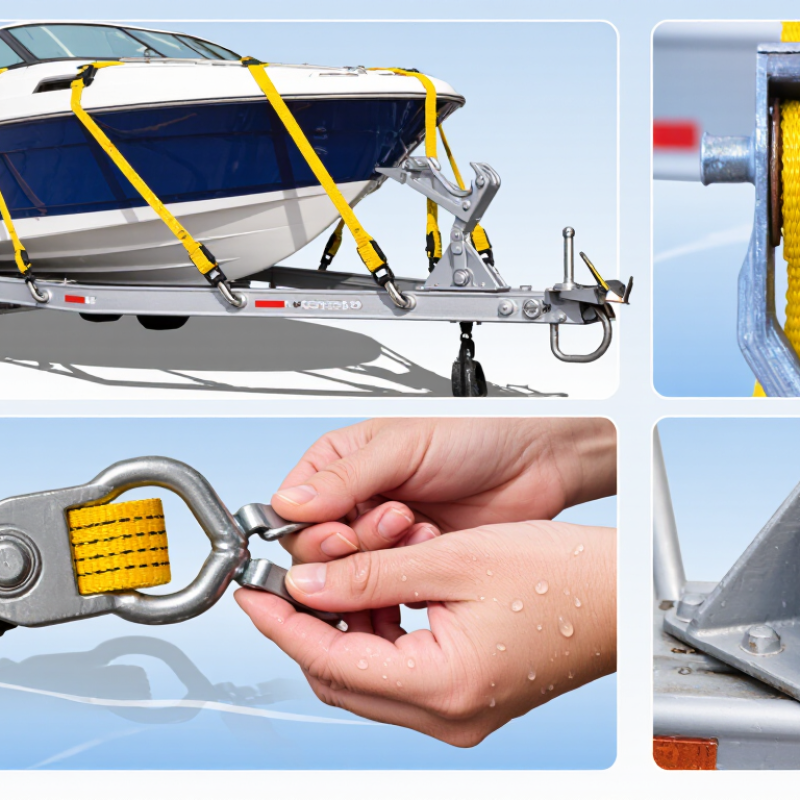
Identify Your Boat and Transport Requirements
Before selecting boat ratchet straps, identify the boat’s type, dimensions, and fully loaded weight. Include the motor, fuel, batteries, and gear; these can change the load substantially. A light aluminum fishing boat and a heavier fiberglass cruiser place different demands on straps and trailer attachment points. Check the boat and trailer manuals for approved tie-down locations. Avoid routing webbing over sharp edges or delicate fittings.
Next, consider how the boat will travel. Short, smooth trips differ from long highway journeys, rough ramps, or frequent launches. Look for each strap’s working load limit, not just its breaking strength, and compare it with your setup’s requirements. Use suitable bow and stern restraints where the manufacturer recommends them. Keep straps snug, but do not crush the hull or bend trailer components. Small detail, big difference.
Salt spray, rain, and sun can wear webbing and corrode ratchets. Inspect stitching, hooks, and ratchet movement before each trip; replace straps that are frayed, cut, or badly rusted. I once thought a strap felt secure simply because the handle locked. That is not a reliable check. Recheck tension after loading and during a stop, especially if the boat or trailer has shifted. A little extra time here is worthwhile.
Compare Strap Materials and Weather Resistance
For boat ratchet straps, compare the webbing, not just the buckle. Polyester is usually a strong choice for exposed decks because it stretches less when wet and generally resists sunlight better than nylon. ASTM D1909’s standard textile reference values list commercial moisture regain at about 0.4% for polyester and 4.5% for nylon. These figures describe moisture held under standard conditions, not water absorbed during every boating trip. Construction and coatings still matter.
Nylon can be useful where some give helps absorb movement, but repeated wetting and drying may make it harder to keep a load equally snug. Salt spray also attacks metal hardware, while grit can wear webbing where it crosses a sharp rail. Look for clear working-load information and inspect stitching, edges, and buckles. For UV comparisons, ASTM G154 provides a controlled accelerated-weathering test method; results help compare samples, but do not predict an exact service life outdoors. Real exposure varies.
Tips: Rinse straps with fresh water after saltwater use, then dry them out of direct sun. Check for faded color, stiff patches, frayed edges, or bent teeth before tightening. I still recheck tension after the boat settles on the trailer; material choice cannot compensate for poor routing.
Choose the Correct Load Rating
When choosing boat ratchet straps, check the working load limit (WLL), not just the breaking strength. Breaking strength describes when a strap may fail in testing; it is not a safe working target. Read the strap label carefully, and use the WLL for planning. Include the boat’s weight with fuel, batteries, and gear aboard. Then consider how many straps will genuinely support the load. They rarely share it evenly. That assumption deserves a second look.
Strap angles, trailer movement, and uneven tension can place extra force on individual straps. Avoid simply dividing the boat’s weight by the number of straps. Select a suitable rating for each strap, following the strap maker’s guidance and the boat or trailer instructions. If the load rating is unclear, don’t guess. Ask a qualified supplier or marine professional. Check that hooks and anchor points are rated for the load too. Before each trip, look for frayed webbing, damaged stitching, bent hardware, or a worn label. A higher rating does not make a damaged strap dependable. Keep straps snug, but avoid excessive tension that could press hard against the hull. A soft protective sleeve can help where webbing touches an edge.
How to Choose the Best Boat Ratchet Straps? — Choose the Correct Load Rating
| Marked Working Load Limit (WLL) | Typical Strap Configuration | Suitable Use | What to Check Before Buying |
| 500 lb (227 kg) | Often found on light-duty, 1-inch webbing assemblies; ratings vary by construction and hardware. | Light-duty securing tasks where the strap’s labeled WLL is sufficient for the load and tie-down arrangement. | Read the tag on the complete assembly. Do not assume all 1-inch straps have the same rating. |
| 1,000 lb (454 kg) | Available in various webbing widths and assembly designs, including some 1-inch and wider straps. | Moderate-duty securing when the required capacity, anchor points, and strap arrangement have been checked. | Confirm the WLL applies to the complete strap assembly, including its ratchet and end fittings. |
| 1,500 lb (680 kg) | Commonly offered on some heavier-duty assemblies; webbing width and hardware differ by product. | Heavier loads only when the tie-down system and trailer attachment points are also rated appropriately. | Check the tag, stitching, hooks, and any manufacturer guidance for use in a marine environment. |
| 3,333 lb (1,512 kg) | A rating offered by some 2-inch strap assemblies; it is not a universal rating for 2-inch webbing. | Higher-capacity applications where this WLL is needed and the whole securing arrangement supports it. | Verify the exact labeled WLL. A strap’s breaking strength is not its WLL. |
| Application-specific | Any width or length with a clearly marked rating suitable for the intended setup. | Boat and trailer tie-downs selected according to the boat’s weight, tie-down direction, number of straps, and attachment points. | Use the lowest-rated component as the practical limit of the system; inspect straps for cuts, abrasion, damaged stitching, corrosion, or faulty ratchets. |
Selection reminder: Base your choice on the labeled WLL, not breaking strength or webbing width alone. Required capacity depends on the load and how the straps are arranged. Follow applicable securement rules and the boat and trailer manufacturers’ instructions. Ratchet straps are for securing loads, not lifting, and should not replace the boat’s winch or safety chain unless the manufacturer specifies otherwise.
Select the Right Strap Length, Width, and Fittings
Choose strap length by measuring the full route between trailer anchors, over the boat’s intended contact points. Boat length alone is a poor guide. Allow enough material for the ratchet to tighten, but avoid long, loose tails that can whip in the wind. Width matters, too: wider webbing spreads pressure across a larger area, but it must fit the ratchet and anchor hardware. Protect the gelcoat with a sleeve or pad where webbing touches the hull. Small details matter.
Match the fittings to the trailer’s anchor points. Use compatible hooks or soft loops, and keep metal hardware away from painted surfaces and rails. The Web Sling & Tie Down Association distinguishes a strap’s working load limit from its breaking strength; compare rated WLL values, not just the strap’s appearance. For highway cargo securement, FMCSA regulation 49 CFR §393.106(d) sets an aggregate WLL benchmark of at least 50% of cargo weight. Treat that as a transport reference, not a substitute for the boat or trailer manufacturer’s instructions. A tempting shortcut is choosing the thickest strap available. It can still be the wrong length or have incompatible fittings.
Check Safety Features and Compatibility
How to Choose the Best Boat Ratchet Straps? Check Safety Features and Compatibility
A strap that fits the boat is not automatically safe. Check its working load limit (WLL), label, stitching, and ratchet before buying. The Working Load Limit should be clearly marked and readable; avoid straps with faded labels, frayed edges, bent hooks, or stiff, corroded gears. The Federal Motor Carrier Safety Administration’s cargo-securement rule requires tiedowns’ aggregate WLL to equal at least half the cargo weight. That rule applies to commercial vehicle cargo, not every recreational boat trailer, but it offers a useful load-checking benchmark. Never treat breaking strength as the usable WLL. They are different numbers.
Compatibility matters at every contact point. Match strap length to the boat and trailer, and make sure hooks sit fully inside the anchor points without twisting. Check that the strap material suits wet, salty conditions; rinse and dry it after use, and replace it if damage appears. A buckle should be reachable without rubbing against a hull edge. I still recheck the tension after loading, because settling can loosen a strap. Small detail. Confirm that tie-down points are designed for securing loads, not just for lifting or mooring. Also, don’t overtighten: excessive pressure can damage a hull or fittings. Even a good strap can be wrong for a particular setup.
How to Choose the Best Boat Ratchet Straps? Check Safety Features and Compatibility
Under the U.S. federal commercial motor vehicle cargo-securement rule, aggregate tiedown working load limit must be at least half the weight of the article being secured. These examples apply only where that rule governs; check local requirements for other situations. Before choosing straps, verify each strap’s labeled working load limit, inspect webbing and ratchets for damage, and confirm the strap width and hardware fit the boat’s approved tie-down points.