The Duravant family of operating companies serve the food processing, packaging and material handling segments.

Choosing String Wound Filter Cartridges in 2026 requires more than matching a micron number to a product label. A cartridge may look suitable on paper, yet fail when viscosity rises, pressure fluctuates, or the fluid carries unexpected particles. Real process conditions matter.
Dr. Elena Marquez, a filtration systems engineer, offers a practical reminder: “The best cartridge protects the process, not merely the specification sheet.” That principle deserves attention. Buyers should examine particle size, flow rate, temperature, chemical compatibility, core strength, end-cap design, and dirt-holding capacity. A 5-micron rating alone tells only part of the story.
Start with the fluid.
Water, solvents, oils, and process chemicals can demand very different media. Polypropylene string, cotton, or glass-fiber constructions may each perform differently under heat and chemical exposure. Viscous fluids can increase pressure drop quickly. A cartridge that performs well during a clean-water test may struggle in production.
The housing also matters. Check dimensions, seal materials, operating pressure, and available changeout space. Small details become expensive problems later. Monitor differential pressure during trials, not only final flow. Record the cartridge’s service life under realistic conditions.
There is no perfect selection. Even experienced engineers revise choices after field data appears. That is an important weakness in many purchasing decisions. A careful 2026 evaluation should compare laboratory results with actual operating behavior. The safest choice is usually the cartridge supported by verified test data, clear technical documentation, and a supplier willing to explain limitations.
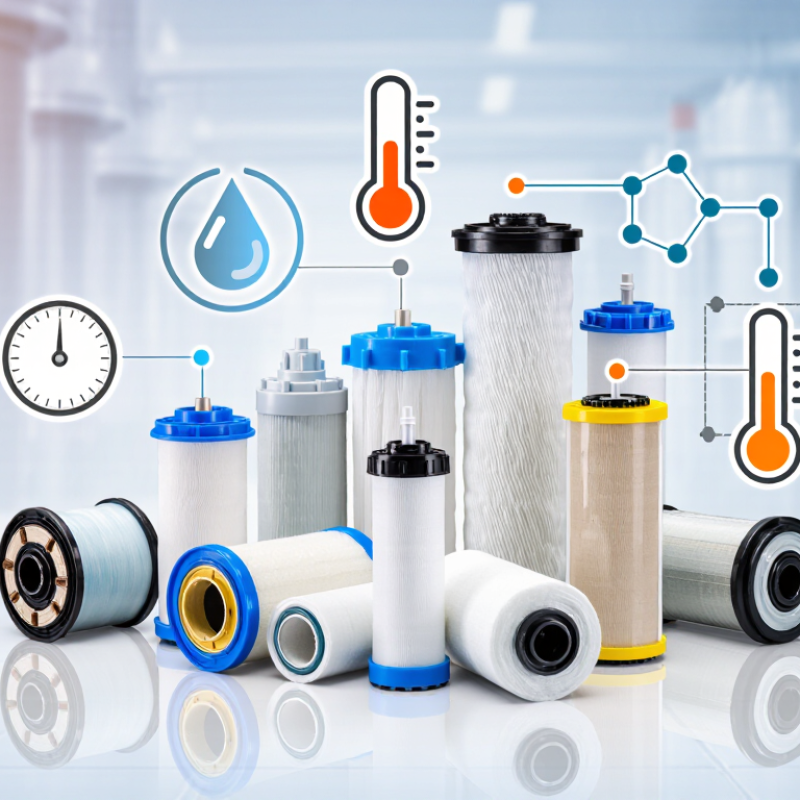
String wound filter cartridges are made by wrapping yarn around a rigid central core. The winding pattern creates passages that trap suspended particles. Larger gaps remain near the outer surface. Smaller spaces form closer to the core. This structure supports depth filtration, rather than simple surface screening.
As water, chemicals, or process liquids move inward, particles collect between the yarn layers. A cartridge rated at 5 microns may capture a range of particle sizes. The stated rating is not magic. Actual performance depends on flow rate, fluid viscosity, temperature, and particle shape.
In field inspections, I check differential pressure regularly. A rising pressure reading often signals loading, channeling, or an unsuitable cartridge. The filter should be replaced before flow becomes unstable.
Choosing a cartridge in 2026 requires more than comparing micron numbers. Confirm the core and yarn materials against the liquid, especially with solvents, oils, or heated fluids. Check the cartridge length, housing fit, expected flow, and allowable pressure drop. Fit matters. A tightly wound cartridge may provide finer control, while a looser design can handle heavier sediment. Not always. Finer filtration may shorten service life and increase pumping costs. Review test data, installation records, and safety guidance from qualified suppliers. I would also test a small batch before changing a production line. That step feels slow. It can prevent an expensive guess.
Matching cartridge material with the target fluid is more important than choosing by micron rating alone. A string-wound cartridge can remove visible particles, yet the wrong fiber may swell, shed, or lose strength. Polypropylene is often suitable for water, mild chemicals, and many industrial fluids. Cotton can provide useful depth filtration for compatible oils, but it may absorb liquid and degrade in wet service. Polyester offers stronger chemical and temperature resistance in many applications. Nylon can work well with certain aqueous fluids, but compatibility must be verified.
Study the fluid’s temperature, viscosity, pH, solvents, and suspended solids. Hot liquid can change fiber behavior quickly. Thick oil may pass slowly through a tightly wound cartridge, increasing pressure drop. In practice, operators should compare clean pressure drop with the expected loading rate. A cartridge that looks efficient on paper may require frequent replacement in a dirty process.
Do not rely on a general compatibility chart alone. Request material data and run a small fluid test when the process is valuable or unfamiliar. Check for swelling, discoloration, fiber release, and changes in flow after exposure. A useful lesson from field testing is simple: the fluid often behaves differently than its specification suggests. We sometimes select a safer material, then discover its filtration life is shorter than expected. That result deserves review, not concealment. The final choice should balance compatibility, filtration depth, service temperature, and practical replacement intervals.
How to Choose String Wound Filter Cartridges in 2026?
Micron rating should match the contaminant, not simply the smallest number available. A 1-micron cartridge can capture finer particles than a 5-micron cartridge, but it may clog quickly in cloudy water. The CDC notes that filters with an absolute pore size of 0.3 microns or smaller can remove many bacteria and parasites, while viruses may pass through. This distinction matters. “Nominal” ratings describe expected performance, not guaranteed removal.
Review the cartridge’s test method and pressure data. ISO 16889 evaluates filter performance through multi-pass testing and beta ratios, offering stronger evidence than a marketing micron label. In practical testing, monitor pressure before and after the cartridge. A rising differential pressure shows loading. However, it does not prove complete contaminant removal. For drinking-water applications, compare certified claims under NSF/ANSI standards, especially when targeting chlorine, lead, or other specific substances. The 2024 EPA PFAS drinking-water regulation also reminds buyers that general particle filtration cannot replace contaminant-specific treatment.
Tips: Start with a 5-micron prefilter when sediment is heavy, then use a finer cartridge downstream. Check flow at the actual operating temperature. Cold water can reduce flow noticeably. Record inlet pressure, outlet pressure, and replacement time. Field experience shows that a cheaper, larger cartridge may outperform a finer one because it lasts longer. Still, every water source is different, and one selection may need revision after real sampling.
| Nominal Micron Rating | Typical Particle Size Addressed | Typical Filtration Performance | Recommended Filtration Stage | Common Applications | Expected Dirt-Loading Capacity | Relative Pressure-Drop Risk | Selection Notes |
|---|---|---|---|---|---|---|---|
| 0.5 µm | Particles approximately 0.5 µm and larger | Very fine nominal filtration; actual retention depends on winding density, fiber geometry, and fluid conditions | Final particulate polishing | High-purity water prefiltration, fine process-water polishing, laboratory utility water | Low to medium | High | Use only when the upstream water is already relatively clean; verify clean pressure drop and flow capacity. |
| 1 µm | Particles approximately 1 µm and larger | Fine nominal filtration with increased resistance compared with coarse grades | Fine prefiltration | Process water, beverage-water prefiltration, fine suspended-solids reduction | Medium | Medium to high | A suitable choice when fine particle control is needed but the feed does not contain heavy sediment. |
| 5 µm | Particles approximately 5 µm and larger | Balanced nominal filtration and flow performance for many general-purpose systems | General fine filtration | Municipal water, cooling-water makeup, equipment protection, prefiltration before finer media | Medium to high | Medium | Often a practical starting point when both particulate reduction and acceptable service life are important. |
| 10 µm | Particles approximately 10 µm and larger | Moderate nominal filtration with generally lower clean pressure drop | Standard prefiltration | General industrial water, irrigation water, cooling circuits, pump and valve protection | High | Low to medium | Choose this grade when the main objective is protecting downstream equipment rather than fine polishing. |
| 25 µm | Particles approximately 25 µm and larger | Coarse nominal filtration with good tolerance for higher sediment loading | Primary prefiltration | Well water, surface water prefiltration, sand and rust reduction, pretreatment before finer filters | High | Low | A strong option for extending the service life of downstream 1–10 µm cartridges. |
| 50 µm | Particles approximately 50 µm and larger | Coarse sediment removal with relatively low resistance when correctly sized | Heavy-load prefiltration | Raw water, construction-site water, irrigation systems, visible sediment removal | Very high | Low | Use as a first-stage filter when the feed contains large particles or noticeable turbidity. |
| 100 µm | Particles approximately 100 µm and larger | Very coarse nominal filtration for large sediment and debris control | Rough prefiltration | Raw-water intake protection, irrigation, cooling-water systems, large-particle removal | Very high | Very low | This grade is intended to protect equipment and downstream filters, not to produce fine or polished water. |
| Important selection guidance: Micron ratings for string wound cartridges are commonly nominal rather than absolute. A nominal rating is not a sharp particle-size cutoff, and removal efficiency varies with cartridge construction, winding density, fiber material, fluid viscosity, temperature, flow rate, and contaminant concentration. An absolute rating should be accepted only when supported by a defined test method and efficiency or beta-ratio data. Select the cartridge using the required flow rate, allowable pressure drop, contaminant load, fluid compatibility, housing dimensions, and replacement-pressure-differential limit. | |||||||
How to Choose String Wound Filter Cartridges in 2026?
Cartridge size should match both housing depth and contaminant loading. A 10-inch cartridge may fit physically, yet provide insufficient surface area for a high-solids stream. Measure peak flow, not average flow. For example, a process running at 30 liters per minute may briefly reach 45 liters per minute during equipment cleaning. That surge can sharply increase pressure loss. The U.S. EPA’s 2020 Water Reuse Action Plan emphasizes site-specific treatment validation because water quality can change significantly within one facility.
Flow rate must come from tested performance data, not a simple catalog estimate. Compare the cartridge’s pressure-drop curve at your actual viscosity, temperature, and micron rating. A lower micron rating usually increases resistance. It may also shorten service life. Keep differential pressure gauges before and after the housing. Many operators schedule replacement near 1.0–1.5 bar differential pressure, but this is only a practical starting point, not a universal rule.
Service life depends on solids concentration and loading patterns. Record inlet turbidity, operating hours, and pressure rise each week. The World Health Organization’s water safety guidance supports monitoring hazards through operational data, rather than relying on fixed replacement dates. A useful estimate is simple: service hours equal the cartridge’s tested dirt-holding capacity divided by daily solids loading. Real systems are less tidy. Fibers can channel, pressure gauges can drift, and one test may not represent winter water. Leave a safety margin. Good filtration decisions sometimes require revising the original sizing.
Cartridge size, flow rate, and service life are closely related. For the same cartridge diameter, increasing the cartridge length generally increases the available filtration area, recommended flow, and contaminant-holding capacity in near-linear proportion.
Use a 10-inch cartridge as the reference size. A 20-inch cartridge provides approximately twice the media length, while 30-inch and 40-inch cartridges provide approximately three and four times the nominal filtration area when the diameter and construction remain the same.
The chart shows conservative clean-water design guidance for a 5-micron nominal string-wound cartridge. Actual flow depends on micron rating, liquid viscosity, temperature, dirt loading, and the filter housing.
Service life is not determined by calendar time alone. Monitor differential pressure and replace the cartridge when the pressure drop reaches the housing or process limit, commonly around 0.7 bar (10 psi), or when the required flow can no longer be maintained.
Reference basis: same-diameter cartridges using the same nominal 5-micron string-wound media. Flow values are practical clean-water design points rather than universal manufacturer ratings; always verify the specific cartridge and housing data sheet.
How to Choose String Wound Filter Cartridges in 2026?
Installation cost is more than the cartridge price. Check the housing size, end configuration, seal material, and available clearance. A cartridge that fits poorly can create leaks and repeated labor. Measure the housing before ordering. Confirm the required flow rate and temperature range from operating records, not assumptions. Installation should also include a pressure gauge or differential pressure indicator. This small detail helps prevent unnecessary replacement.
Maintenance costs depend on dirt-loading behavior and working conditions. Replace cartridges according to pressure rise, not only a calendar schedule. Record inlet and outlet pressure during each inspection. In one plant, operators changed filters monthly, although some still had useful capacity. That habit increased waste and labor. However, extending service too far can restrict flow and stress downstream equipment. The correct interval may change with seasonal water quality. It is not always predictable.
Operating cost deserves careful comparison. A low-cost cartridge may produce higher pressure loss as it loads. Pumps then consume more energy, especially during long operating hours. Compare expected service life, replacement frequency, disposal needs, and energy use per cubic meter. Ask suppliers for test conditions behind their capacity claims. Results can vary greatly with particle size and fluid viscosity. A spreadsheet helps, but it can create false confidence. Real-site trials are often wiser. Keep the first trial modest, document the pressure trend, and revise the selection when field evidence disagrees.