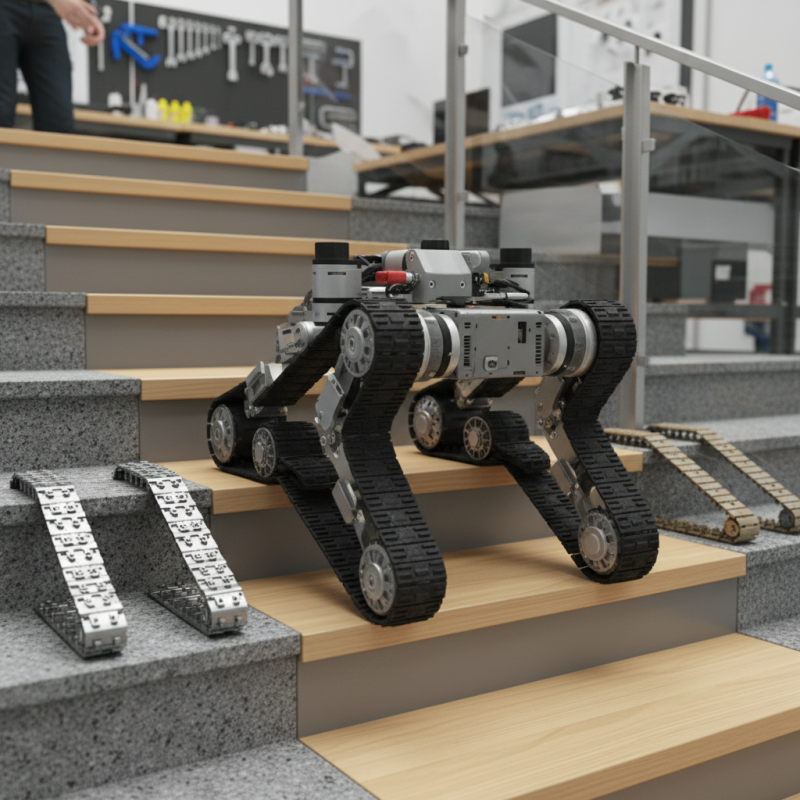
How to Choose the Best Stair Climbing Robot Tracks for Your Needs?
When choosing the best Stair-Climbing Robots Tracks, it's essential to understand your specific needs. Stair-climbing robots tracks come in various designs and materials, each suited for different environments. Consider factors such as weight capacity, terrain type, and intended use.
The right tracks can significantly impact the robot's performance. For instance, rubber tracks may provide better grip on smooth surfaces, while metal tracks excel on rough or steep stairs. It's crucial to evaluate these aspects before making a decision.
However, not all options will meet your expectations. Users often overlook the importance of compatibility with their existing equipment. Research, read reviews, and perhaps consult experts to gain a clearer perspective on what works best for your situation. Making a thoughtful choice can save time and enhance efficiency.
Understanding Different Types of Stair Climbing Robots Available in the Market
When selecting a stair climbing robot, it’s crucial to understand the various types available in the market. Stair climbing robots can vary significantly in design and capability. Some are compact and designed for home use, while others are larger, built for industrial applications. Each type serves different needs, so it’s important to find the right fit for your specific requirements.
For instance, some robots feature tracks for better stability on uneven surfaces. These tracks can navigate staircases with a variety of conditions, providing a reliable solution for moving heavy loads. However, not all models perform equally in challenging environments. Observing user feedback can shine a light on which products excel and which ones fall short. Importantly, make sure to consider weight limits. Some models may struggle under heavy loads, leading to potential safety concerns.
A notable point is accessibility. Some robots may not be user-friendly for everyone, particularly the elderly or differently-abled. Ensuring ease of use can significantly impact satisfaction. Researching functionality and understanding limitations is essential. Identifying the right type often involves trial and error, so expect to make adjustments as you discover what works best in real-life applications.
Key Features to Consider When Selecting Stair Climbing Robot Tracks
When selecting stair climbing robot tracks, key features can greatly impact performance and safety. The first aspect to evaluate is traction. The material and design of the tracks should provide a solid grip on various surfaces. This prevents slips and enhances stability during operation.
Another crucial feature is weight capacity. Ensure the robot can support the load required for your specific needs. Heavy loads demand robust tracks that can withstand pressure without compromising functionality. Consider the size of the tracks as well. They should fit your robot and stairs seamlessly, allowing for smooth navigation.
Tips: Look for user reviews to gauge real-world performance. Assess the ease of installation as well. A complicated setup can lead to frustration and wasted time. Always verify product specifications closely. A mismatch can lead to disappointing results and safety hazards. Reflect on your unique environment and consider trial options if available.
Assessing Your Specific Needs and Environment for Stair Climbing Robots
When choosing stair climbing robots, understanding your specific needs is crucial. Different environments present varying challenges. For instance, homes with narrow stairs require robots with slim designs and flexible maneuverability. According to a recent market study, 65% of users prioritize the robot’s ability to navigate tight spaces. Meanwhile, for commercial applications, stability on steeper inclines becomes a key factor.
Stair climbing robots are not one-size-fits-all. The type of surface you encounter can also affect your choice. Robots designed for carpeted stairs will differ from those intended for concrete. Recent research shows that 72% of users encounter different types of stair surfaces. This statistic underscores the importance of assessing your environment carefully. Users should also consider the weight capacity of the robot. Many models struggle with heavier loads, which can lead to performance issues.
Product reviews indicate that not all robots handle uneven surfaces effectively. This aspect often requires additional tests for performance assurance. Ensuring that the robot can adapt to different stair designs is vital. A robot that excels in one area could underperform in another. Take time to evaluate how various features may serve your unique circumstances.
How to Choose the Best Stair Climbing Robot Tracks for Your Needs?
| Feature | Description | Importance Level |
| Weight Capacity | Maximum weight the robot can handle for safe operation. | High |
| Track Type | Type of tracks (rubber, steel, etc.) for durability and traction. | Medium |
| Battery Life | Duration the robot can operate before needing a recharge. | High |
| Size and Dimensions | Overall size, especially width, for maneuvering in tight spaces. | Medium |
| Stepping Height | Height of stairs the robot can effectively navigate. | High |
| Speed | How fast the robot can move up or down stairs. | Low |
| User-Friendliness | Ease of control and usability from a user perspective. | High |
| Safety Features | Braking systems, sensors to prevent falls, etc. | Very High |
Evaluating Performance Metrics: Load Capacity, Speed, and Battery Life
When selecting a stair climbing robot, understanding performance metrics is crucial. Load capacity is a key factor. It determines how much weight the robot can carry. A robot that handles heavy loads efficiently reduces the need for multiple trips. Consider your specific requirements. An overly powerful robot may be unnecessary, while a weaker one could compromise safety.
Speed is another important metric. A faster stair climber saves time but may sacrifice precision. If the robot moves too quickly, it could slip or fail to navigate steep steps. Testing various speeds in realistic scenarios helps users find the right balance. This trial and error approach often reveals important insights.
Battery life significantly impacts usability. A longer battery life means extended operational time, reducing the need for frequent recharging. However, a robot with high capacity may weigh more, affecting mobility. Assess how long you need the robot to operate between charges. Evaluating battery efficiency may provide surprising results. Sometimes, a lighter option performs better, despite shorter battery life. Balancing these metrics can be challenging, but it’s essential for making an informed choice.
Comparing Costs and Maintenance Requirements of Stair Climbing Robot Tracks
When selecting stair climbing robot tracks, costs play a significant role. The average price can range from $3,000 to $7,500. This wide range reflects different capabilities and technologies. Users should consider budget constraints versus the functionality they require. Many consumers are not aware that additional costs, like maintenance, can add up.
Maintenance is an area often overlooked. Regular servicing can cost around $300 annually for basic upkeep. More complex repairs may rise to $1,000. The longevity of the tracks heavily depends on use frequency. Data reveals that robots used daily may need parts replaced within two years, while less frequent use can extend life.
While some tracks promise low maintenance, users may find this misleading. For instance, components such as battery packs and wheels wear down faster than expected. Research indicates that tracking these wear patterns can help avoid unexpected costs. Users can benefit from a detailed analysis of long-term expenses versus initial investment.