The Duravant family of operating companies serve the food processing, packaging and material handling segments.

Choosing the right Cable Protection Sleeve is rarely as simple as comparing prices or appearance. Global buyers face different cable sizes, temperatures, installation methods, and shipping conditions. A sleeve used behind a control panel may need different protection than one fitted around outdoor power cables. Small details matter.
This guide reviews seven practical options for international purchasing teams, electrical contractors, equipment manufacturers, and maintenance professionals. Each product is considered through material quality, abrasion resistance, flexibility, temperature performance, installation speed, and expected service life. We also examine whether the sleeve can handle tight bends, repeated movement, oil exposure, dust, or vibration. Real projects are not always clean. Cable bundles may be uneven, access may be limited, and installation teams may work with incomplete measurements. That reality deserves attention.
Performance claims need evidence. Reliable suppliers should provide clear specifications, sample testing, traceable production information, and responsive technical support. A low-cost sleeve can become expensive when it splits during installation or traps heat around sensitive wiring. We will also note practical weaknesses, because no product fits every environment. Some sleeves protect well but feel stiff. Others install quickly but offer limited resistance against sharp edges. These trade-offs are easy to overlook.
Use this comparison as a starting point, not a final decision. Check actual cable diameter, movement, temperature, and exposure before ordering. Test samples whenever possible. Better decisions come from careful measurement, honest evaluation, and a little skepticism.
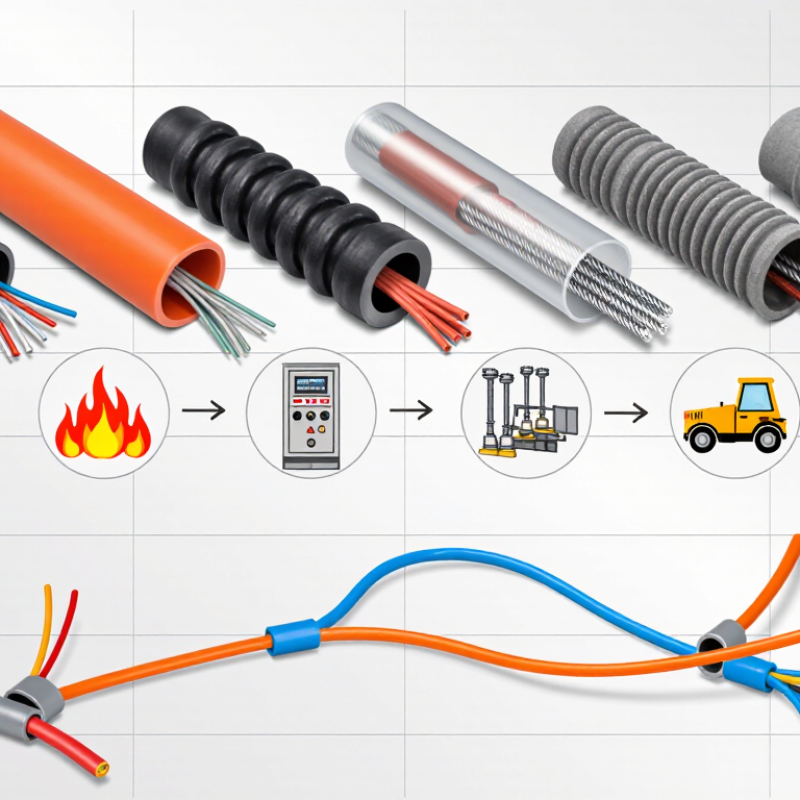
Cable protection sleeves are flexible covers placed around wires, harnesses, or cable bundles. They help resist abrasion, dust, splashes, heat, and repeated bending. In a workshop, an exposed cable can rub against a sharp panel edge within days. A suitable sleeve creates a buffer between the cable jacket and that damaging surface.
They also improve handling and maintenance. Bundled cables become easier to route, label, and inspect. Some sleeves offer flame-resistant, expandable, braided, or split designs for different installations. However, protection is never automatic. A tight sleeve may restrict movement, while a loose one may slide and expose weak points. During cable inspections, I have seen both problems. The sleeve looked correct, but its ends were poorly secured. That small detail reduced its practical value. Buyers should check operating temperature, inner diameter, flexibility, chemical exposure, and installation space. Regional electrical and safety requirements should also be confirmed before purchase.
Tips: Measure the cable bundle at its widest point. Leave room for movement. For outdoor use, test resistance to sunlight and moisture. For machinery, examine bend cycles and edge contact. Request material data and inspection records from the supplier. A sample trial is wiser than relying only on photographs. Even experienced buyers can miss heat buildup inside dense bundles. Check it before placing a large order.
7 Best Cable Protection Sleeves for Global Buyers
When comparing cable protection sleeves, start with the working environment, not the product label. A sleeve used behind factory machinery needs different protection from one installed inside an office cabinet. Check abrasion resistance, operating temperature, moisture exposure, and resistance to oils or mild chemicals. These details often decide service life.
Measure the cable bundle carefully. A sleeve that is too tight can restrict movement and increase installation stress. One that is too loose may slip, collect dust, or fail to protect bending points. Look for suitable inner diameter, flexibility, expansion range, and closure design. Braided sleeves are useful for irregular bundles, while split designs can simplify maintenance. Test the sleeve around connectors and sharp entry points before purchasing large quantities.
Material quality also matters. Polyamide, polyester, fiberglass, and heat-resistant fabrics perform differently under heat, friction, and repeated movement. Review technical data, test methods, and traceable quality records from the supplier. Ask whether samples were tested under conditions similar to your application. In my experience, laboratory ratings can look impressive but may not reflect vibration, dirt, or poor routing on site. I once selected a sleeve by temperature rating alone and overlooked its limited flexibility. That mistake made installation slower. Cost, shipping consistency, documentation, and replacement availability should also be compared for international purchasing. Short trials reveal more than assumptions.
Key Factors for Comparing Cable Protection Sleeves
The chart compares common cable protection sleeve types using typical performance scores from 1 to 5. Higher scores indicate stronger performance in abrasion resistance, flexibility, heat resistance, liquid protection, and installation ease. Actual performance depends on material grade, wall thickness, closure design, and operating conditions.
Cable protection sleeves vary by routing conditions, movement, heat, and installation speed. In sourcing projects, I commonly evaluate seven types. Braided sleeving expands around irregular cable bundles and offers clean abrasion resistance. Split loom tubing opens along its length, making repairs easier on installed wiring. Spiral wrap suits branching cables because sections can exit at different points. It is flexible, but repeated movement may loosen poorly fitted wraps.
Expandable PET sleeving works well for lightweight harnesses and provides a neat woven finish. Fabric wrap sleeves reduce noise and rubbing, especially inside equipment panels. Corrugated conduit gives stronger mechanical protection in exposed routes, though its bends require more space. Heat-shrink tubing creates a tight seal around terminals and joints. It needs accurate sizing and controlled heat; rushed installation can damage insulation.
I check wall thickness, temperature range, bend radius, and flame-performance data before ordering. Measurements should include connectors, not only cable diameter. A sleeve that fits the wire may fail at the plug. During inspection, I flex samples repeatedly and inspect frayed edges, gaps, and shrinking marks. Visual quality alone can mislead. I once favored a tidy woven sleeve, but it restricted a moving cable more than expected. Small installation trials are still necessary for global buyers.
7 Best Cable Protection Sleeves for Global Buyers
How to Choose the Right Sleeve for Each Cable Application
Selecting the best cable protection sleeve starts with the cable’s actual working environment. A sleeve for a quiet office differs from one beside a vibrating engine. Measure the cable bundle, including connectors, before choosing diameter. Leave enough room for movement, but avoid excessive looseness. A loose sleeve can snag on brackets. It can also collect dust and moisture. Expandable braided sleeves work well around irregular bundles. Split sleeves suit cables that are already terminated. Short labels help during maintenance.
Match the material to the main hazard, not the product photograph. Seven practical options include expandable braid, split braid, heat-shrink, spiral wrap, flexible conduit, abrasion-resistant fabric, and fire-resistant fiberglass sleeving. Use abrasion-resistant fabric near sharp metal edges. Choose heat-shrink protection where a tight, sealed fit matters. Spiral wrap allows branch connections and frequent access. Flexible conduit offers stronger mechanical coverage in exposed routes. For heat, chemicals, flame, or sunlight, request documented test results. Do not rely on vague terms such as heavy duty. Check wall thickness, recovery ratio, bend radius, and installation temperature. Small details matter.
Global purchasing adds practical questions. Confirm metric and imperial sizing, packing lengths, color options, and replacement availability. Ask whether the sleeve remains flexible after repeated bending. A sample test is more reliable than a catalog image. I once selected a sleeve by diameter alone; it fit, but the connector pulled against the edge. That mistake changed my process. Now I bend, pull, and rub a sample before approving a larger order. The test is simple, though not perfect. Record service conditions and installation limits clearly for the installer.
| Protection Sleeve Type | Typical Material | Suitable Cable Diameter | Typical Temperature Range | Main Protection Function | Best Cable Application | Key Advantages | Important Limitations | Selection Rating |
|---|---|---|---|---|---|---|---|---|
| Expandable Braided Sleeve | Polyester (PET) monofilament and multifilament braid | Approximately 3–25 mm; expands to accommodate irregular shapes and connectors | Typically −50°C to +150°C | Abrasion, chafing, light impact, and cable-bundle protection | Automotive harnesses, control cabinets, robotics, appliance wiring, and general cable management | Lightweight, flexible, easy to install, allows heat dissipation, and provides good coverage for curved cable routes | Not a sealed waterproof barrier; open braid can allow dust and liquid penetration | Best Overall |
| Split-Braided Sleeve | Slit PET braided sleeving with a longitudinal opening | Approximately 6–50 mm; suitable for pre-assembled cable bundles | Typically −50°C to +150°C | Abrasion protection and retrofit bundling | Existing wiring looms, maintenance work, server wiring, industrial control panels, and cable assemblies with attached connectors | Can be fitted without disconnecting cables; quick installation and easy access for inspection or repair | Less resistant to pull-out and displacement than a closed braided sleeve; usually requires end fixing | Best for Retrofit |
| Hook-and-Loop Wrap Sleeve | Woven polyester or nylon fabric with hook-and-loop closure | Approximately 10–60 mm, depending on wrap width and cable bundle size | Typically −40°C to +125°C | Abrasion, light crushing, organization, and repeated access protection | Data centers, office equipment, audio-video systems, test benches, and frequently modified cable bundles | Reusable, openable along the entire length, easy to add or remove cables, and suitable for field maintenance | Generally offers lower heat and abrasion resistance than industrial braided or fiberglass sleeves; closure may collect dust | Best for Maintenance |
| Spiral Wrap | Polyethylene (PE) or nylon (PA) | Approximately 3–50 mm; available in multiple inner diameters and spiral pitches | PE: typically −40°C to +85°C PA: typically −40°C to +125°C | Light abrasion protection, cable bundling, and controlled branching | Desk wiring, control panels, machinery, battery cables, and installations requiring branch exits | Low cost, flexible, easy to cut, and allows individual cables to exit at selected points | Does not provide continuous coverage; cables remain partly exposed between spiral turns | Best for Branching |
| Corrugated Flexible Conduit | Polypropylene (PP), polyethylene (PE), or polyamide (PA) | Approximately 5–50 mm internal diameter; larger sizes are available for industrial routing | Typically −40°C to +120°C, depending on polymer and construction | Mechanical impact, abrasion, crushing, and routing protection | Automotive wiring, machinery, factory automation, outdoor equipment, and cable runs exposed to movement | Higher mechanical protection than open braid; flexible, crush-resistant, and compatible with conduit fittings | Not automatically watertight; the assembly requires suitable end fittings and seals for liquid protection | Best for Impact Protection |
| Silicone-Coated Fiberglass Sleeve | Texturized fiberglass braid coated with silicone rubber | Approximately 3–30 mm internal diameter; select a size that fits freely over the cable | Typically −60°C to +260°C; short-term limits may vary by construction | High-temperature, flame, molten-splash, and abrasion protection | Motors, generators, ovens, furnaces, welding equipment, engine compartments, and high-temperature electrical leads | Excellent thermal resistance, flexible installation, electrical insulation, and good resistance to sparks and hot particles | Bulkier and more expensive than PET sleeves; the coating can be damaged by sharp edges or severe flexing | Best for High Heat |
| Stainless-Steel Braided Sleeve | 304 or 316 stainless-steel wire braid | Approximately 6–50 mm; choose the inside diameter based on bundle size and installation clearance | Typically suitable for continuous exposure up to approximately +500°C, depending on wire grade and construction | Severe abrasion, cutting, mechanical impact, rodents, and high-temperature protection | Industrial furnaces, foundries, heavy machinery, marine systems, and areas exposed to sharp or abrasive hazards | Very high mechanical strength, excellent abrasion resistance, non-combustible metal construction, and strong chemical durability | Heavier, less flexible, and more difficult to terminate; it is electrically conductive and requires insulation or grounding where necessary | Best for Severe Duty |
Note: Temperature ranges, diameter ranges, and performance values are typical industry ranges. Actual limits depend on material grade, wall construction, flame-retardant treatment, installation method, flexing cycle, and exposure conditions. Always verify the supplier’s technical datasheet and applicable regional safety requirements before purchase.
Global buyers need more than a low unit price when choosing cable protection sleeves.
The best option depends on temperature, abrasion, moisture, flexibility, and installation space. Common choices include braided PET, expandable nylon, split conduit, spiral wrap, heat-shrink tubing, fiberglass sleeving, and heavy-duty woven covers. Each design solves a different problem.
Check the technical file before placing a large order. Ask for tested temperature ranges, flame behavior, chemical resistance, and material composition. Relevant standards may include IEC methods, UL requirements, RoHS restrictions, or regional electrical rules. However, compliance markings do not replace verification.
Requirements can change by destination, cable voltage, and equipment category. Request recent test reports, batch records, and clear product dimensions. A sleeve that fits one cable bundle may restrict another.
Maintenance often decides service life.
Inspect sleeves for frayed fibers, cracked coatings, flattening, or loose closures. Dust can hide early damage. In humid areas, allow ventilation and prevent water from collecting inside the sleeve. Replace damaged sections instead of wrapping them repeatedly with tape. That shortcut sometimes fails.
During purchasing, confirm minimum order quantities, packaging protection, spare lengths, and delivery conditions.
Samples should be tested on the real cable path, including bends and moving points. I would not trust a perfect laboratory result alone. Field conditions are usually less polite.